

Authenticity, Augmented
Pangram, boob jobs, nodal shifts, and the astrology of now.

Earlier this week, I stepped away from Substack and focused on client work.
Yes, I am an actual human being. And I actually like working with other actual human beings.
Yesterday, I met with someone who happened to be an old friend but was also a new client. He had never worked with a coach before — and definitely never with one who weaves esoteric practices into the work.
I explained that I always schedule initial client sessions for 90 minutes.
He scoffed at the meeting request.
“Is this really going to take that long?”
The next day, I hopped back into what felt like my abandoned Substack account.
When I logged in, the brilliant JHong had posted a Note referencing the use of Pangram.
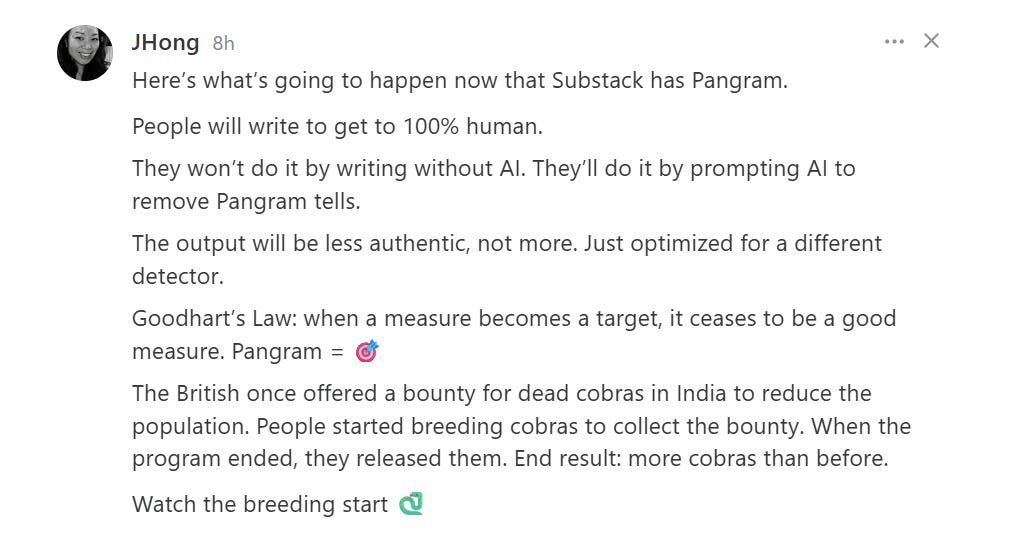
I was out of the loop — as I am with most of Jennifer’s analyses, which is precisely why I subscribe to her Natural Intelligence.
So I Googled Pangram.
It is a site that estimates how much of a piece may have been generated by AI. Apparently, Substack had announced a partnership with Pangram earlier this week.
I found Jennifer’s Note fascinating, astrologically aligned, and personally timely.
This past week, I had been feeling internal pressure about how I could provide more value to my subscribers — both paid and unpaid.
To tell you that using more AI never crossed my mind would… well.
I have actively resisted becoming dependent on AI with Cosmic Sushi.
Cosmic Sushi has been my astrological playground. My oasis. My public love letter to the cosmos, peppered with the occasional profanity and laced with innuendo.
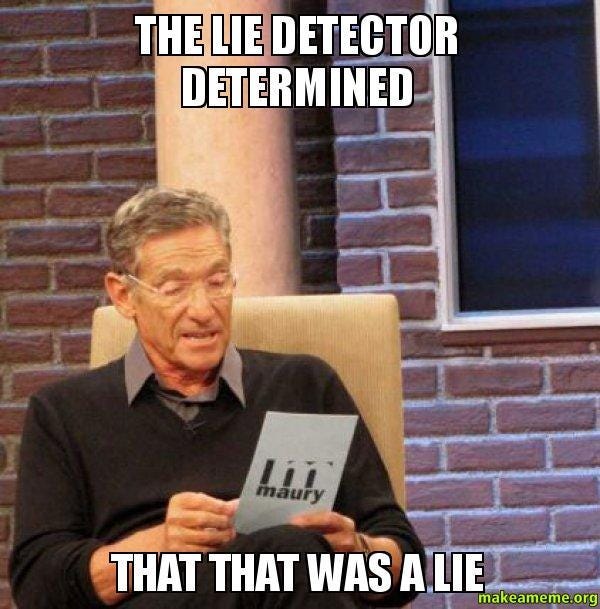
To say I do not use AI today would also be a lie.
I use AI for my article banner art. I use it to edit articles before publishing. I use it to wargame possible titles. My Cosmic Sushi avatar is clearly not a self-portrait.
You do know that, right?
With my natal Jupiter — the planet of expansion, knowledge, meaning, and abundance — in Gemini, the sign of curiosity, duality, wit, and mental stimulation, I often begin my written projects with a thesis.
But then the thesis acquires cousins.
And side quests.
And one deeply compelling observation that belongs in an entirely different article.
What begins as an intended three-minute read becomes 1,200 words before I have even teed up the premise of the post.
My natal Jupiter is also in the 12th house. Much of that intellectual abundance develops privately, internally, and beneath the surface before it ever reaches the page.
By the time you see the article, I may have already had six different versions of the conversation with myself.
And I’m always talking to myself.
My unnamed LLM helps me remove, on average, about 30% of the unnecessary mental clutter from my work.
If only it could do the same thing to my actual brain.
My natal Mercury — the planet of communication, language, thought, and movement — is retrograde in Aries. Mercury also disposes my Jupiter in Gemini.
In plain English: I ignite quickly.
I lead with instinct. I follow the hot take. I move fast enough to mentally outrun the structure.
Then, because Mercury is retrograde, I double back. I revise. I rethink. I discover that the conclusion was hiding somewhere inside paragraph fourteen.
What starts strong can become recursive, sprawling, and exhausting before I land the dismount.
AI helps me remember where I started.
It helps me identify the article buried beneath the article.
It helps me make sure the ending belongs to the beginning.
One of the most frequent questions I ask my unnamed AI is:
“How much of this piece is me, and how much is you?”
The fear is not merely that I use it.
The fear is that one day I will no longer know what my writing sounds like without it.
“How much is me?” I also ask myself.
The conversation around Pangram lit up my synapses so intensely that I had to message Jennifer about it.
We all see writers on Substack who clearly use AI.
You can feel it.
The writing is too smooth. Too perfect. It uses diction no human being would ever use in ordinary conversation.
But polish itself is not the problem.
Strong editors existed before ChatGPT.
The real tell is the sudden absence of the person.
For some writers, the distinction between their Notes and their Posts is especially dramatic.
Their Notes sound casual, unvarnished, and alive.
Their articles suddenly read like they’ve been anesthetized: full of safe advice, polished conclusions, and nothing sharp enough to move the needle in anyone’s life.
The lack of congruence can be disorienting for the reader.
Which ‘voice’ is real?
Who are you?
And which version am I actually following?
Our Already-Augmented Reality
On TikTok — my not-so-dirty little secret distraction — another conversation has been emerging on my For You Page.
Botox.
Filler.
False lashes.
Hair extensions.
Looksmaxxing.
Upper blephs.
Boob jobs.
BBLs.
GLP-1s.
The list goes on.
It got me thinking: we already live in an augmented reality.
Have you ever attended a 3D movie?
Used a filter on a selfie?
Put a virtual background behind you on a Zoom call?
Taken a little blue pill for, ahem, stuff?
When we do any of the above, aren’t we augmenting reality too?
These augmentations are not ethically identical.
Using a Zoom background is not the same as publishing an article written entirely by a machine under your own name. Editing your work is not the same as outsourcing authorship. Ten units of Botox is not ghostwriting.
But all of these things complicate the fantasy that what we encounter in public is ever wholly un-assisted.
Large creators, writers, influencers, celebrities, and politicians have joined Substack.
You know the ones.
They arrive and, within a week, have more than 100,000 followers and are suddenly “Rising.”
For almost all of them, reality is augmented too.
We simply have more tolerance for their augmentation.
Editors.
Ghostwriters.
Publicists.
Marketers.
Researchers.
Brand strategists.
Entire production teams.
Some of the largest creators on Substack write almost exclusively about why I am an idiot for not using enough AI to scale.
What is “reality” for them?
What is authentically theirs?
Are smaller creators being held to standards of creative purity that we do not apply to larger ones with invisible infrastructures?
Perhaps authenticity is not the absence of assistance.
Perhaps it is congruence between the person, the process, and the voice being presented.
The Astrology of the Moment — and Why This Is Heating Up
Jupiter, the planet of expansion, growth, and blessings, is currently in the fiery sign of Leo.
Ruled by the Sun — the central star of our solar system — Leo is fixed fire.
It is the archetype of courage, creativity, art, drama, romance, self-expression, and the eternal flame.
The Sun will enter Leo at the time of this article’s publication.
With the Sun at home in Leo, joined by Jupiter, there may be a growing desire to protect the creative spark.
To claim authorship.
To shine more brightly.
To be recognized for what only we can create.
But Jupiter does not merely expand creativity.
It can also inflate the creative ego.
It can magnify self-mythology, performance, visibility, and the belief that our personal expression deserves the only audience.
Jupiter will travel through Leo from June 29, 2026, until July 26, 2027. During this passage, Jupiter will form an opposition to Pluto in Aquarius.
Pluto is our infamously demoted dwarf planet of power, evolution, destruction, and resurrection.
In Aquarius, a fixed air sign symbolized by the Water Bearer, Pluto transforms the collective systems that shape how we live.
Technology.
Networks.
Platforms.
Mass movements.
Social belonging.
Surveillance.
Collective intelligence.
And the invisible concentrations of power embedded inside systems that promise to democratize everything.
Or so they say.
Jupiter in Leo asks:
What happens to the individual creative flame when it becomes larger, brighter, and more visible?
Pluto in Aquarius asks:
Who owns the systems that distribute, amplify, measure, imitate, and possibly replace that flame?
Jupiter in Leo wants creative sovereignty.
Pluto in Aquarius exposes the power structures surrounding creativity.
It can also describe the fear of being socially outcast for using — or refusing to use — the tools embraced by the collective.
So the conversation about Pangram, Substack, AI, and whether a piece acquires more or less status depending on how it was made is completely aligned with the astrology of the moment.
But on Sunday, July 26, 2026, at 7:48 p.m., the Nodes shift out of Pisces–Virgo and into Aquarius–Leo.
The debate becomes even more nuanced.
The North Node in Aquarius points toward experimentation, innovation, collaboration, collective intelligence, and new ways of creating.
It asks us not to fear what is unfamiliar merely because it challenges our established methods.
But the shadow of Aquarius is depersonalization.
Disembodiment.
Algorithmic sameness.
The outsourcing of individual judgment to the group, the platform, or the machine.
The South Node in Leo describes familiar patterns around identity, performance, personal recognition, and the desire to be the singular genius at the center of the story.
We may need to release our overidentification with applause.
Our dependence on being visibly special.
Our tendency to confuse attention with value.
But we are not meant to abandon the gifts of Leo.
Heart.
Courage.
Warmth.
Play.
Personal authorship.
The creative flame itself.
The lesson is not:
Technology good. Human ego bad.
Nor is it:
Human creativity pure. Technology corrupting.
The work of the Aquarius–Leo axis may be learning how to use collective technologies without surrendering the individual creative flame.
My Own Aquarius–Leo Struggle
Going back to the session yesterday, it did not last 90 minutes.
It lasted more than three hours.
The client could not explore enough.
At the end, he asked whether we could book the next session for this week.
I told him I would love to schedule it for next week.
Why?
Because I had a Substack article to write.
Here is the truth:
If I started publishing more frequently and included Sun-sign horoscopes for all twelve signs, I could probably grow faster.
That would certainly feed the expansive appetite of Jupiter in Leo.
Sun-sign horoscopes are human catnip.
They are familiar. Easy to enter. Readers can immediately find themselves inside the work.
There are gifted astrologers who can write twelve Sun-sign horoscopes and still make each one feel alive. I respect the work. I also know I am not called to do it.
Personally, I would burn out writing twelve forecasts.
I would initially want to do all of them myself.
Then I would become bored because my Mercury is in Aries.
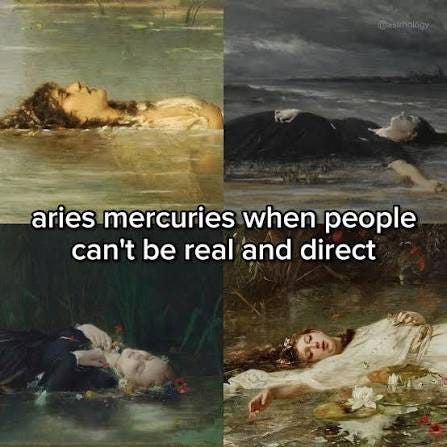
Image from astrhology on Instagram
Then I would feel tempted to “cheat” and have AI generate them for me.
But the misalignment would not be due to the machine itself.
The South Node in Leo temptation would be building a creative performance around what earns applause instead of what keeps my creative flame alive.
It would be choosing a format that is easier for readers to enter, but not one I feel called to sustain.
It would be manufacturing twelve versions of intimacy for simply audience capture.
It would be prioritizing visibility over my own creative conviction.
Sun-sign horoscopes are generalized out of necessity.
A single horoscope cannot understand all the nooks, crannies, contradictions, and hidden passageways inside your divine design.
That does not make the form illegitimate.
It simply means it is not the form of astrology I feel called to create.
AI is very good at synthesizing astrological knowledge quickly.
It can organize symbolism.
It can compare archetypes.
It can help locate patterns across an enormous body of information.
What AI cannot do as easily is bring a lived-in perspective.
Pattern recognition shaped by actual consequence.
The embodied knowledge of what it feels like to be a soul in human skin.
It cannot sit with a skeptical client for three hours while a conversation becomes something neither person could have planned in advance.
It cannot care whether the person on the other side of the screen feels more courageous after reading.
AI helps me smooth out my Jupiter-in-Gemini mental sprawl so I can give you what you may actually need in the moment.
A laugh.
A warning.
An astrological pep rally when the energy gets hard — and it does.
A strategy for navigating moments with real human consequences.
Or a glimpse of the one pattern in your chart that may be quietly holding you back.
So, do I use AI?
Yes, I do.
After I handwrite four pages on a legal pad.
While drinking an iced coffee.
Thinking about you.
If this made you question what “authenticity” even means anymore, welcome to Cosmic Sushi.
I write about astrology, culture, power, pattern recognition, and the strange ways the simulation reveals what is shifting before the rest of us have found language for it.
Subscribe for sharper reads, darker humor, astrology with teeth, receipts, and the occasional reminder that we are all in this cosmic soup together.
This was probably the best article I could have read this morning. Thank you for your art, words, technologies, collaboration-cheering. ☕️🌞
Your article left me with one question: What's more important, the prose or the ideas the prose is putting on the page?
Reading this made me realize my concern is almost the opposite. I'm not afraid of losing my voice. I'm hoping that, as I get better at articulating my thoughts, the writing becomes a more faithful expression of them. For me, the challenge isn't preserving the prose. It's making sure the prose never becomes more important than the ideas it's trying to carry.
Now my brain hurts and I need my cat to knead it! 🐈 😝